![HER[AI]TAGE](https://her-ai-tage.pou-cakovec.hr/wp-content/uploads/2025/03/logo-1.png)
![HER[AI]TAGE](https://her-ai-tage.pou-cakovec.hr/wp-content/uploads/2025/03/logo-2.png)
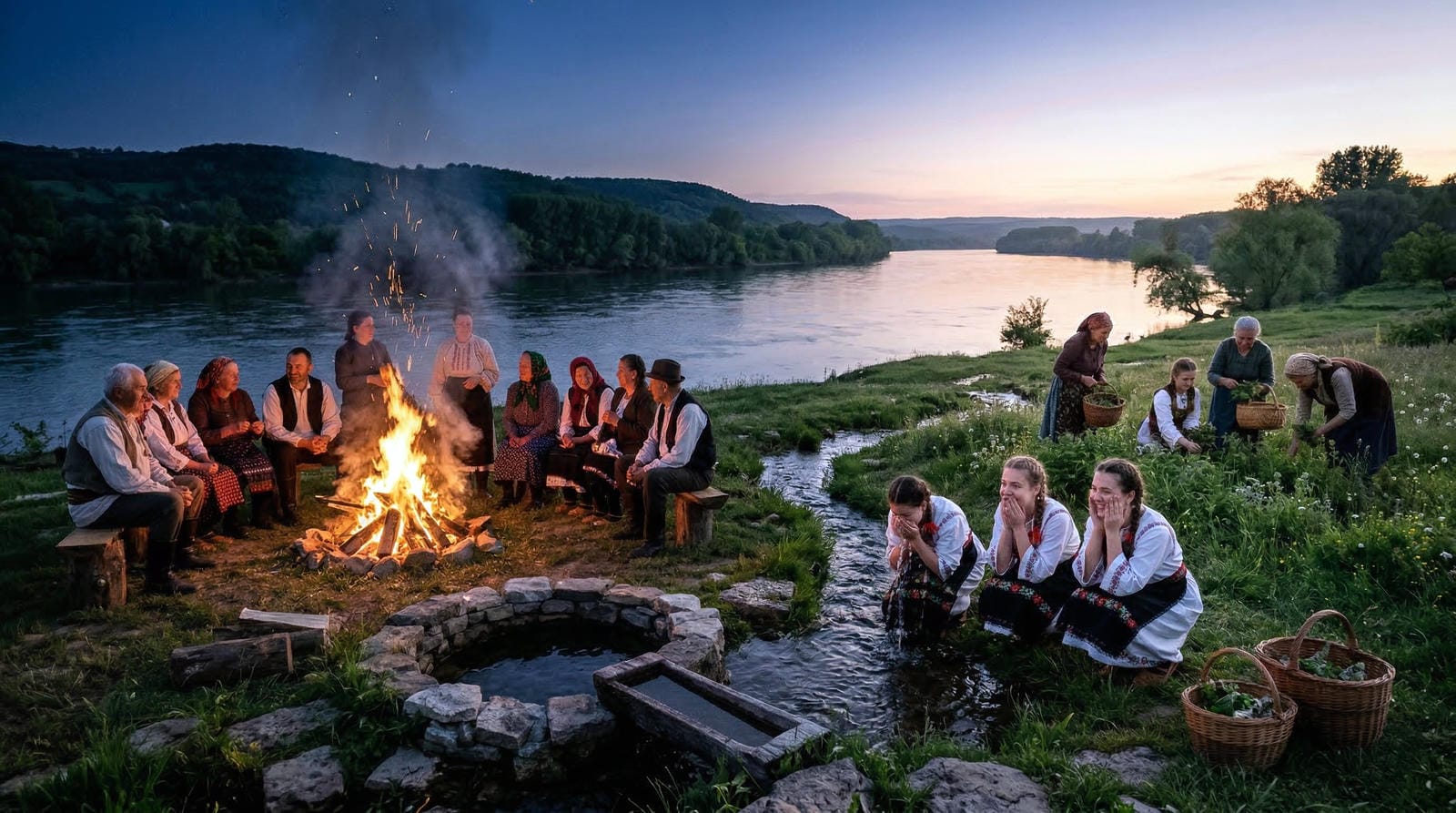
On the very bank of the Danube is the Kozarica spring, where St. George’s Day early risings used to take place. We went to the spring and there the local priest performed the service. The patron saint day in Čortanovci is St. George’s Day, May 6th. A day earlier, on the afternoon of May 5th, locals gathered by the Danube at that spring. A fire was lit and people sat by it all night. They waited for dawn so the girls could wash their faces with spring water for health. Students also went there and picked lovage along the way. In the morning of May 6th, people went to the village and gates were opened to welcome guests. In Srijem, the custom is not to invite guests for the village patron saint day, but simply to come. After the war, the locals were wise so they invented the May 1st Labour Day picnic to preserve that custom of gathering by the river. Now the spring is arranged. Records say that Saint Sava stayed there when he went to reconcile his brother Stefan the First-Crowned with the Hungarian King Andrew II. The Kovilj Monastery was built on the occasion of that reconciliation.

#IntangibleCulturalHeritage #WaterQualityProtection #FolkloreAndOralTradition #CulturalLandscapes #CommunityLedHeritageManagement
Describing the intangible cultural heritage of St. George’s Day gatherings at the Kozarica spring, this story notes how locals would wash their faces for health. It links this custom to legends of Saint Sava and the continuity of the practice through changing political times. The narrative highlights the sacredness of water and the role of community-led heritage management in preserving these meaningful cultural landscapes.
The protection of such springs combines the WFD with cultural heritage protection. The adaptation of the custom shows the resilience of heritage communities. The site is a potential stop on cultural routes. The spring is an indicator of groundwater health.
Spring restoration projects can involve the community. Cultural events can revive traditional gatherings. Water heritage mapping can identify sacred springs. Interpretive signage can explain hydrogeology and folklore. Inclusion in pilgrimage routes promotes tourism.
Sources:
https://www.coe.int/en/web/culture-and-heritage/faro-convention
http://www.nacionalnarevija.com/en/tekstovi/br%2082/03%20Cortanovci.html
https://environment.ec.europa.eu/topics/water/groundwater_en
The story you have just read is an authentic record of an elder’s experiences who participated in the HER[AI]TAGE project. While the content is original, the text may have been lightly edited for optimal clarity, flow, and readability. The accompanying visuals and audio recording were created responsibly with AI technology to enrich the storytelling experience while preserving the foundational authenticity of the presented story.
AI tools used: Google Gemini via Google AI Studio.