![HER[AI]TAGE](https://her-ai-tage.pou-cakovec.hr/wp-content/uploads/2025/03/logo-1.png)
![HER[AI]TAGE](https://her-ai-tage.pou-cakovec.hr/wp-content/uploads/2025/03/logo-2.png)
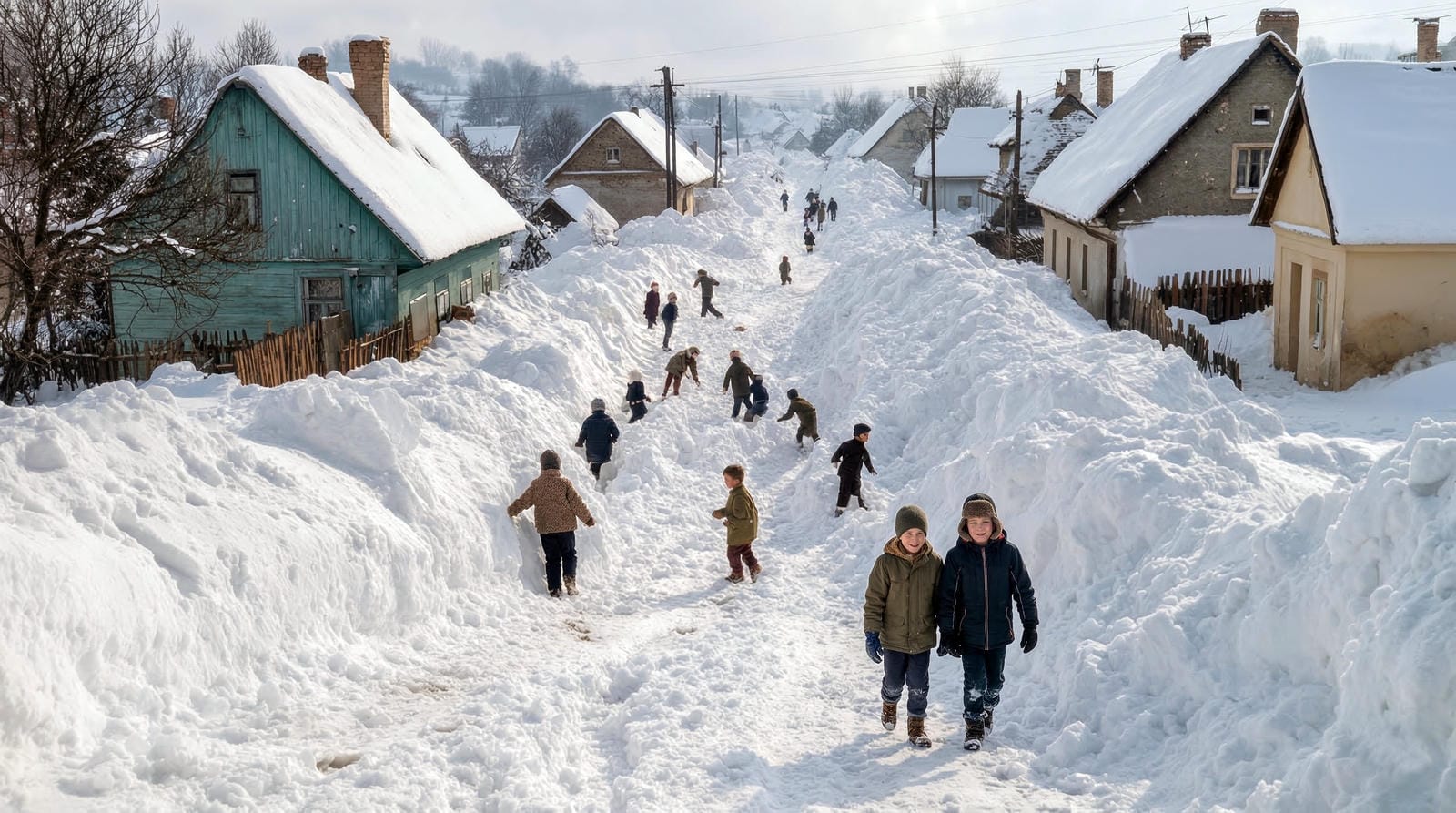
I remember that as children in 1965, before the great flood, we played in the street. Parents made passages in the deep snow, but we couldn’t see each other over those drifts so we called out to one another. That was very amusing to us. That year, after the snow, the flood came. After that cute memory of playing came a completely different experience because our house was flooded. That night it was already known that it would be critical because of the large amount of snow. We children eavesdropped on parents’ stories from around the corner and watched the preparations. Although it was summer when the water rose, the night was full of activity. I remember that sandbags were being collected and the army was mobilised with entire machinery.

#ClimateChangeAdaptation #FloodplainRestoration #CommunityLedHeritageManagement #FreshwaterEcosystemManagement #EnvironmentalEducation
Recounting the great flood of 1965 through a child’s eyes, this story captures the contrast between winter play in “snow labyrinths” and the later disaster. It highlights the community’s action and vulnerability when facing extreme weather, touching on climate change adaptation and community-led heritage management. The narrative links the water cycle of snowmelt to flooding, emphasizing the need for floodplain restoration and being prepared.
The flood is a benchmark for risk assessments under the EU Floods Directive. The link between snowmelt and flooding is critical for river basin management. The narrative underscores the need for plans that integrate historical memory. Climate change is altering these patterns.
Flood memory archives can maintain risk awareness. Participatory planning of flood defences involves local communities. Natural water retention measures can manage snowmelt. Education for disaster risk reduction uses local history. Commemorative markers keep the memory alive.
Sources:
https://environment.ec.europa.eu/topics/water/floods_en
https://warwick.ac.uk/research/impact/arts/scapvc/flood-memory
https://www.icpdr.org/main/activities-projects/flood-risk-management
The story you have just read is an authentic record of an elder’s experiences who participated in the HER[AI]TAGE project. While the content is original, the text may have been lightly edited for optimal clarity, flow, and readability. The accompanying visuals and audio recording were created responsibly with AI technology to enrich the storytelling experience while preserving the foundational authenticity of the presented story.
AI tools used: Google Gemini via Google AI Studio.