![HER[AI]TAGE](https://her-ai-tage.pou-cakovec.hr/wp-content/uploads/2025/03/logo-1.png)
![HER[AI]TAGE](https://her-ai-tage.pou-cakovec.hr/wp-content/uploads/2025/03/logo-2.png)
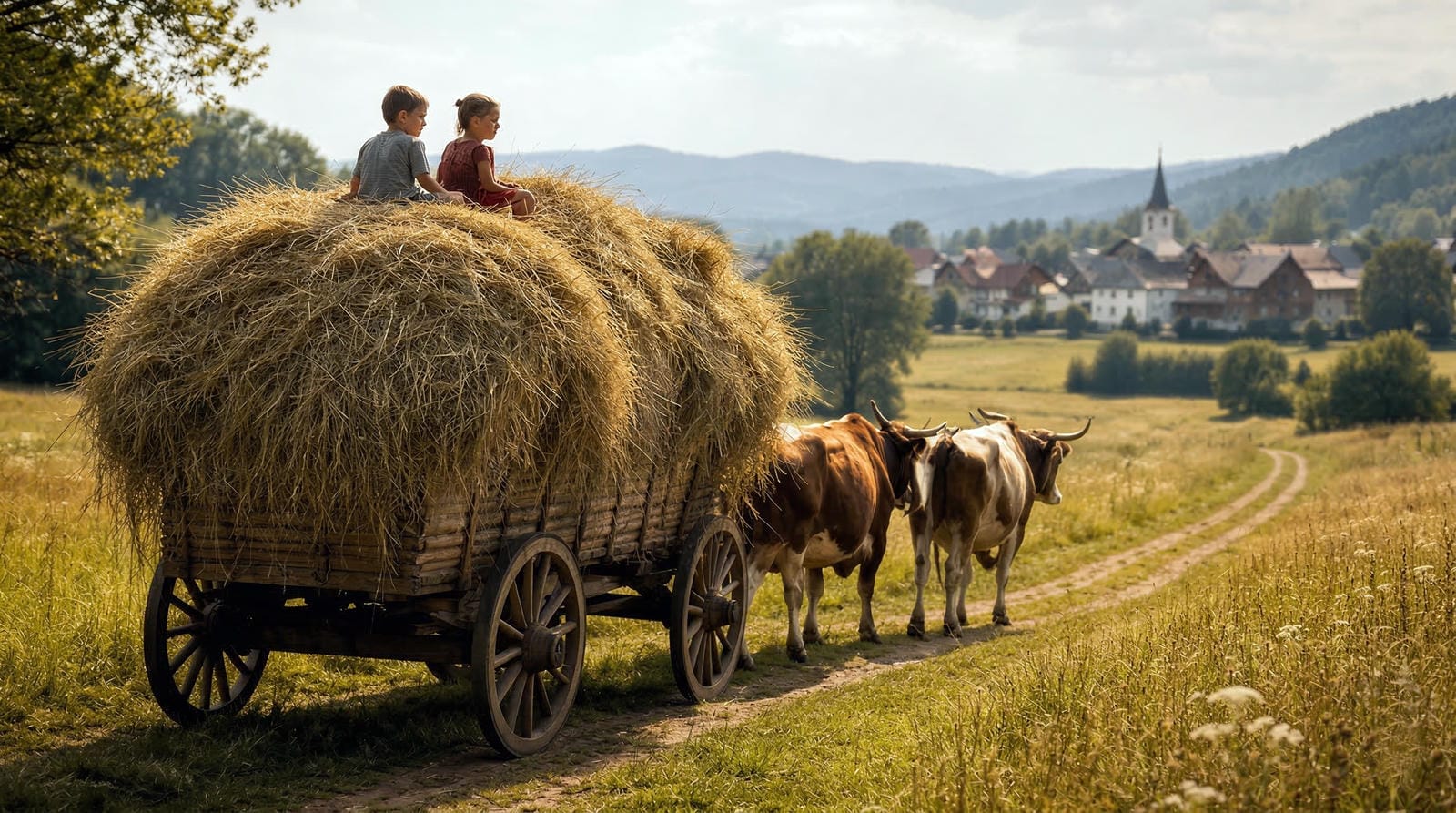
Sometimes there were no tractors. When I was smaller, they yoked two cows and a wagon. Grass was first mown by hand and then dried in the sun. This hay was precious food for the livestock. We walked a lot through the meadows and turned the grass so it would dry in time. Then we had to rake it into piles, yoke the cows, and load the hay onto the wagon. We children also helped and raked. Our greatest joy was if the pile of hay wasn’t too high and they put us on top of the wagon. That’s how we slowly rode home. Even today, I have that healthy and fragrant scent of dry hay in my nose when I remember those days. It was beautiful.

#SustainableAgriculture #CulturalLandscapes #TraditionalEcologicalKnowledge #IntangibleCulturalHeritage #BiodiversityConservation
This story focuses on the smells and feelings of traditional haymaking, a hard job that involved the whole family. It describes high nature value farming methods that kept grasslands full of life through manual mowing. The narrative emphasises the joy and deep connection to the land found in this work, contrasting it with modern machines and highlighting the intangible cultural heritage embedded in rural life.
Traditional hay meadows are among the most threatened habitats in Europe, protected under the Habitats Directive. The Common Agricultural Policy includes agri-environment-climate measures to support farmers who maintain these low-intensity practices. The story illustrates the cultural value of high nature value farming, which the EU Biodiversity Strategy aims to protect. The loss of such practices contributes to the abandonment of rural areas, a challenge addressed by the EU’s Long-Term Vision for Rural Areas.
Agri-environmental schemes can provide financial incentives for manual or low-impact mowing. Scything competitions and festivals can keep the skill alive and attract tourists. Hay milk certification creates a market for products from such systems. Educational farms can demonstrate these traditional methods to show the link between farming practices and biodiversity. Landcare associations can organise volunteers to help maintain these landscapes where mechanisation is difficult.
Sources:
https://agriculture.ec.europa.eu/common-agricultural-policy_en
https://agriculture.ec.europa.eu/farming/geographical-indications-and-quality-schemes_en
The story you have just read is an authentic record of an elder’s experiences who participated in the HER[AI]TAGE project. While the content is original, the text may have been lightly edited for optimal clarity, flow, and readability. The accompanying visuals and audio recording were created responsibly with AI technology to enrich the storytelling experience while preserving the foundational authenticity of the presented story.
AI tools used: Google Gemini via Google AI Studio.