![HER[AI]TAGE](https://her-ai-tage.pou-cakovec.hr/wp-content/uploads/2025/03/logo-1.png)
![HER[AI]TAGE](https://her-ai-tage.pou-cakovec.hr/wp-content/uploads/2025/03/logo-2.png)
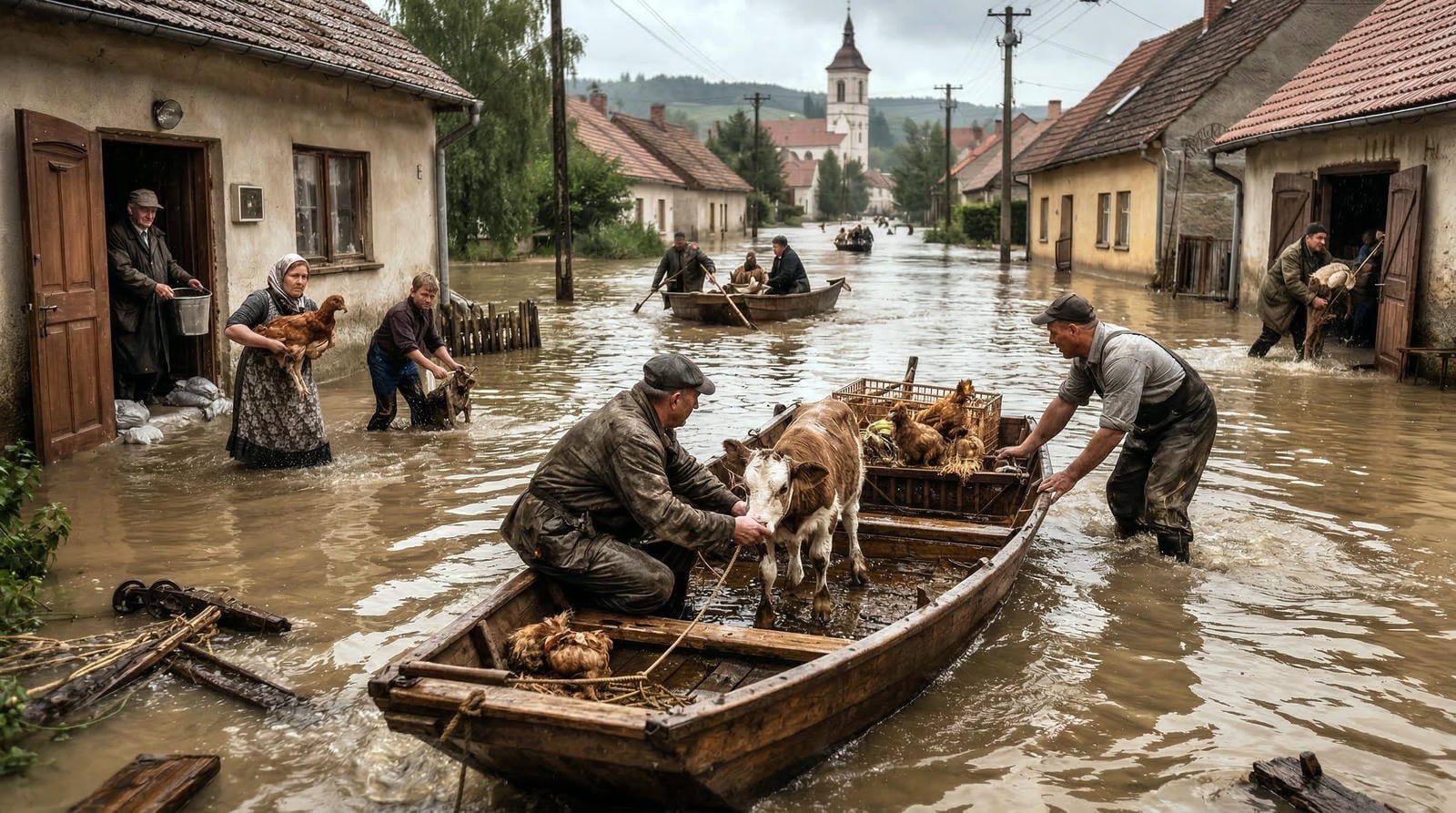
The greatest danger in childhood was the floods of the Trnava. I remember the last big one from 1965 when the southern part of Čakovec was flooded. People prepared rubber boots, lifted animals to the attic, and used stable doors as a boat. At my grandmother’s in Podbrest, I used to swim in the Drava where there was a mill and an old riverbed. Today the Drava no longer flows at that place, and a swamp remains. I also notice the disappearance of animals. There are no more fireflies, butterflies, and swallows. Only a multitude of pigeons and crows remain. Once, the community repaired the damage itself, and solidarity was limited to neighbours’ help. Today, ecological changes are more obvious, but awareness of nature protection is not yet strong enough.

#FloodplainRestoration #ClimateChangeAdaptation #BiodiversityConservation #CommunityLedHeritageManagement #RiverConnectivity
Recounting the devastating flood of 1965, this story highlights the community’s independence and unity during the disaster. It also serves as an ecological record, noting the disappearance of specific species like fireflies and swallows, which signals a drop in biodiversity. The mention of the dried-up riverbed links river regulation to habitat loss, emphasizing the need for river connectivity and more awareness of nature protection.
The flood event serves as a reference point for flood risk management in the Danube basin, relevant to the EU Floods Directive. The observation of species loss aligns with reports showing declines in farmland and riverine birds. The drying riverbed illustrates the hydromorphological pressures addressed by the WFD and the target of the Biodiversity Strategy to restore free-flowing rivers. The text supports the need for nature-based solutions for flood defence.
Floodplain restoration is the primary transferable practice, reconnecting side-arms to restore flow and habitat. Oral history archives of flood events can inform modern flood risk management plans by capturing local knowledge of water behaviour. Citizen science monitoring of indicator species can track biodiversity recovery. Educational campaigns focusing on the link between river regulation and biodiversity loss can raise public awareness.
Sources:
https://www.drava-life.hr/en/home/
https://environment.ec.europa.eu/topics/water/floods_en
https://www.eea.europa.eu/publications/state-of-nature-in-the-eu-2020
https://environment.ec.europa.eu/strategy/biodiversity-strategy-2030_en
The story you have just read is an authentic record of an elder’s experiences who participated in the HER[AI]TAGE project. While the content is original, the text may have been lightly edited for optimal clarity, flow, and readability. The accompanying visuals and audio recording were created responsibly with AI technology to enrich the storytelling experience while preserving the foundational authenticity of the presented story.
AI tools used: Google Gemini via Google AI Studio.