![HER[AI]TAGE](https://her-ai-tage.pou-cakovec.hr/wp-content/uploads/2025/03/logo-1.png)
![HER[AI]TAGE](https://her-ai-tage.pou-cakovec.hr/wp-content/uploads/2025/03/logo-2.png)
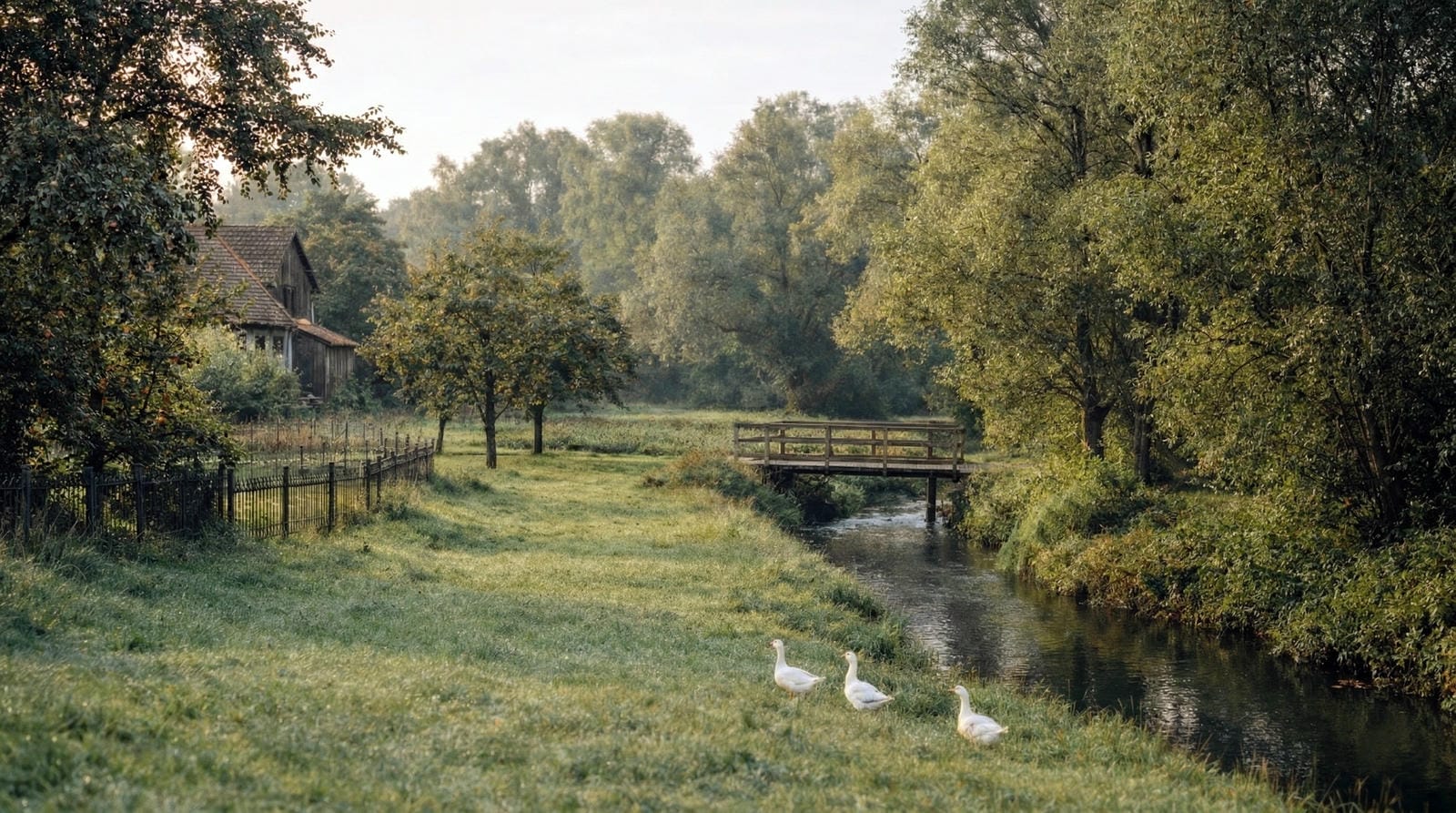
I remember our fairgrounds by the Trnava the most. I remember the iron fence, rows of mulberry trees and willows, and the small wooden bridge towards Dunjkovec. Fairs were not frequent. When there were none, all of that was our realm. We children constantly climbed trees, raced across the meadow, and hid around the bridge. At my grandmother’s house, it smelt of bread for the whole week. The garden was full of fruit trees, and I knew every branch. In the morning, geese would fly out of the barn, and I would run across the dewy grass towards the Trnava and listen to the water flowing. Today, houses stand there. There are no more iron fences or fairs, and the area has lost its old charm. Nostalgia remains, but also gratitude. That was my happiest childhood. I remember the silence without cars, a meadow full of children, and the Trnava flowing as if it would never stop.

#UrbanBiodiversity #CulturalLandscapes #FreshwaterEcosystemManagement #SoilHealth #GreenInfrastructure
The narrator recalls growing up in the semi-natural spaces along the Trnava stream, a place that used to be full of fruit trees, open meadows, and freedom to play. This lively environment, rich with the smells and sounds of nature, stands in stark contrast to the modern reality of asphalt and housing that has taken its place. The story clearly shows the loss of cultural landscapes and urban biodiversity, emphasising how removing green spaces lowers the quality of life and breaks the connection to nature for future generations.
The urbanisation of the Trnava stream corridor touches upon issues central to the EU Soil Strategy for 2030, which aims to achieve no net land take by 2050 to protect fertile soils from sealing. The degradation of the stream’s surroundings also relates to the EU Strategy on Green Infrastructure, which promotes the integration of biodiversity-rich areas into spatial planning. The loss of urban green space is a driver for the EU Nature Restoration Law, which includes targets for increasing urban green space. Additionally, replacing permeable meadow surfaces with asphalt exacerbates flood risks, running counter to the EU Floods Directive.
Restoration of the Trnava stream can be approached through nature-based solutions, such as re-naturalising riverbanks and creating green corridors within the city, as demonstrated in the Eco Bridge project. This Interreg-funded project focused on restoring ecological diversity in urban parks and border areas. Participatory planning involving local residents can help redesign remaining open spaces to reflect the community’s memory, integrating heritage interpretation into modern urban design. Also, urban gardening schemes could be introduced to replace the lost orchards, re-establishing the link between city dwellers and food production as encouraged by the Farm to Fork Strategy.
Sources:
http://www.huhr-cbc.com/en/foundend-projects/343
https://environment.ec.europa.eu/topics/soil-health/soil-strategy-2030_en
https://environment.ec.europa.eu/topics/nature-and-biodiversity/green-infrastructure_en
https://environment.ec.europa.eu/topics/nature-and-biodiversity/nature-restoration-law_en
The story you have just read is an authentic record of an elder’s experiences who participated in the HER[AI]TAGE project. While the content is original, the text may have been lightly edited for optimal clarity, flow, and readability. The accompanying visuals and audio recording were created responsibly with AI technology to enrich the storytelling experience while preserving the foundational authenticity of the presented story.
AI tools used: Google Gemini via Google AI Studio.