![HER[AI]TAGE](https://her-ai-tage.pou-cakovec.hr/wp-content/uploads/2025/03/logo-1.png)
![HER[AI]TAGE](https://her-ai-tage.pou-cakovec.hr/wp-content/uploads/2025/03/logo-2.png)
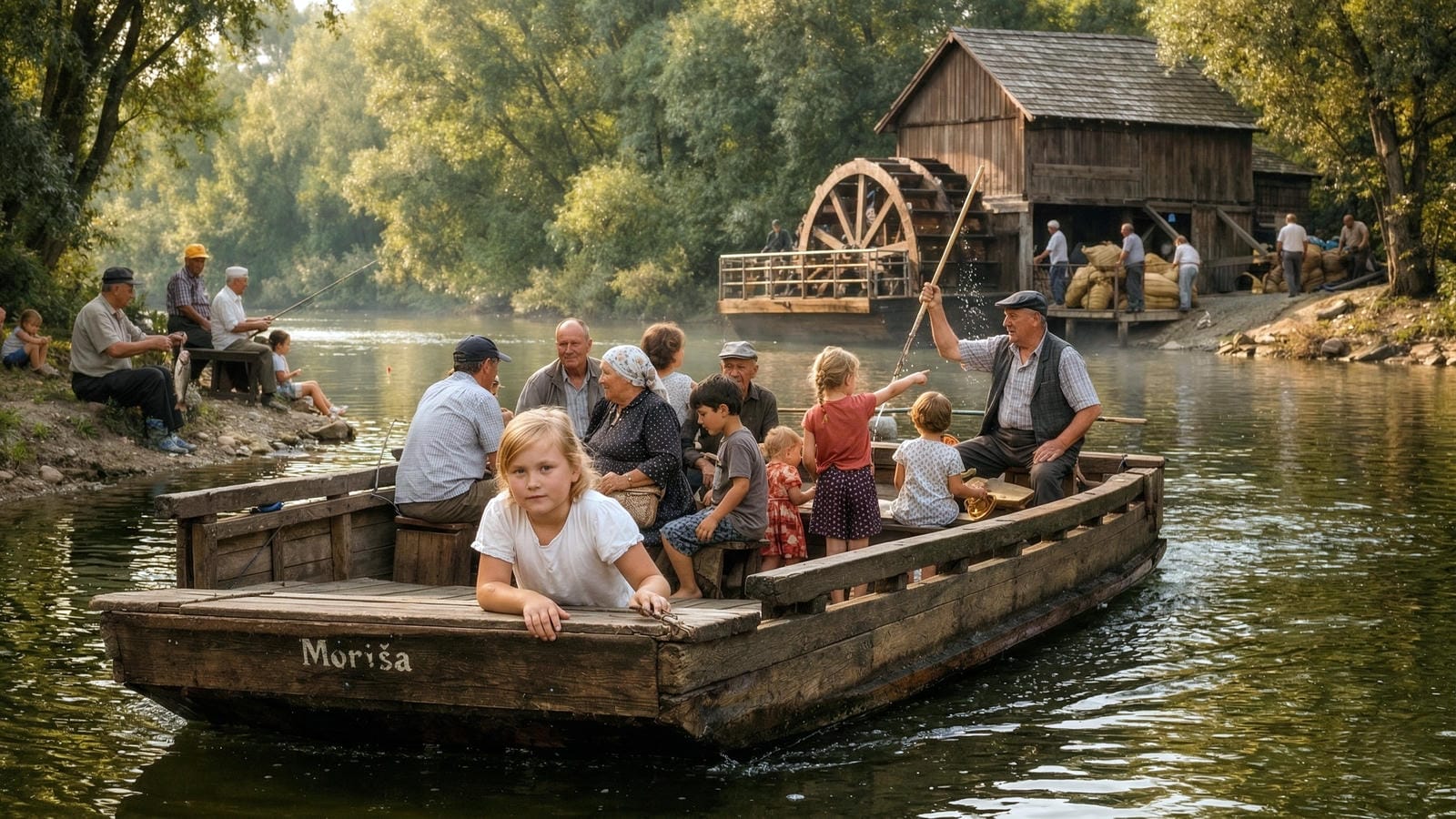
My childhood was tied to the Mura. I liked riding on the boat Moriša the most, although I was afraid of the water because I didn’t know how to swim. People fished along the Mura. There was partying and laughter, and the forest by the river was our playground. I also remember the mill where we took corn. I always watched with amazement as the grain turned into flour. Today Dekanovec has changed a lot. That forest is gone, and the people I knew have died. Nostalgia remains in me because the images of childhood and youth always return. When I come to my homeland, I almost don’t recognise it, but my heart pulls me to stand on the bank of the Mura one more time and cross with the old ferry.

#FreshwaterEcosystemManagement #CulturalLandscapes #RiverConnectivity #HumanNatureCoexistence #SustainableTourism
This story takes us back to a childhood defined by the Mura River, where days were spent boating, fishing, and playing in the riverside forest. The narrator contrasts these vivid memories with the current landscape, pointing out that the forests are gone and the traditional ferry that once connected people has disappeared. This sense of loss highlights how much people love their home environments and shows how physical changes to a river – often caused by building infrastructure or regulating the water – can break the deep emotional bonds between a community and its local nature.
From a policy view, the story shows the challenges addressed by the EU Water Framework Directive, which mandates the protection of surface waters and the achievement of good ecological status. The degradation of the riparian forest described reflects the pressures of hydromorphological alterations that the WFD and the EU Biodiversity Strategy 2030 seek to reverse. The EU Biodiversity Strategy specifically targets the restoration of free-flowing rivers, recognising that barriers and channelisation sever the natural connectivity that supports both biodiversity and human interaction. Furthermore, the Mura River is part of the transboundary UNESCO Biosphere Reserve Mura-Drava-Danube, where sustainable development is promoted alongside nature conservation.
To fix the disconnection described in the story, sustainable tourism projects like the Amazon of Europe Bike Trail have been set up to give value to the river landscape. This approach connects the river corridor through a long-distance route, promoting ferry crossings as heritage experiences. Another transferable practice is the restoration of traditional river crossings as part of soft mobility strategies, which reduce carbon footprints while maintaining tangible cultural heritage. Educational programmes can utilise local river knowledge to teach younger generations about river dynamics and navigation history, thereby preserving intangible cultural heritage linked to the river.
Sources:
https://www.amazon-of-europe.com/projects/
https://environment.ec.europa.eu/topics/water/water-framework-directive_en
The story you have just read is an authentic record of an elder’s experiences who participated in the HER[AI]TAGE project. While the content is original, the text may have been lightly edited for optimal clarity, flow, and readability. The accompanying visuals and audio recording were created responsibly with AI technology to enrich the storytelling experience while preserving the foundational authenticity of the presented story.
AI tools used: Google Gemini via Google AI Studio.