![HER[AI]TAGE](https://her-ai-tage.pou-cakovec.hr/wp-content/uploads/2025/03/logo-1.png)
![HER[AI]TAGE](https://her-ai-tage.pou-cakovec.hr/wp-content/uploads/2025/03/logo-2.png)
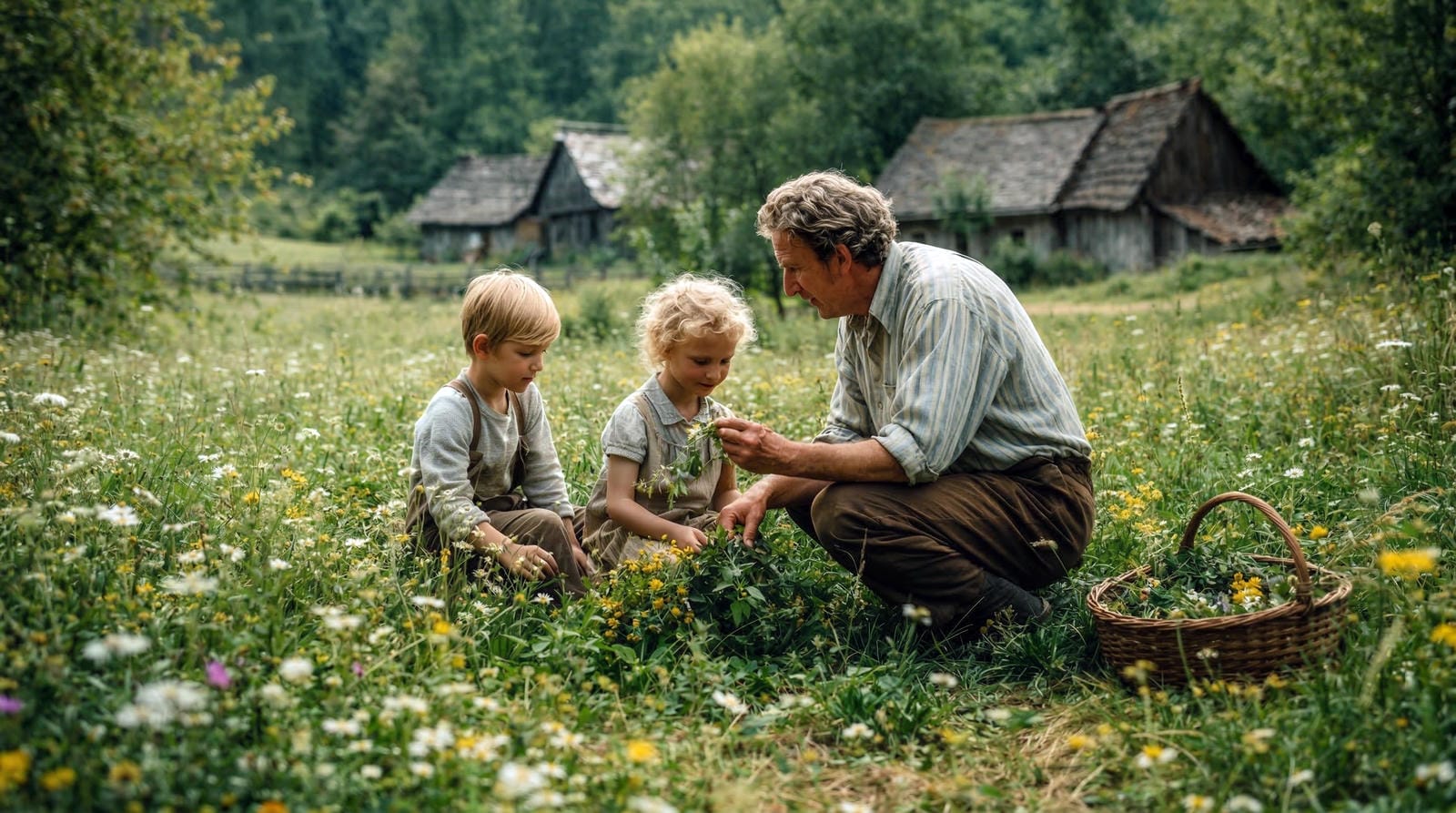
My grandfather was very renowned in the village. They called him the cow obstetrician because he helped calves come into the world. If a sick animal was born, grandfather knew immediately which grass it had to eat and where it needed to be mown. They also healed us with nature. If a bee stung you, they told us to put an onion on the sting. For a wasp sting, we used mud from the ground or even saliva.

#TraditionalEcologicalKnowledge #EthnoveterinaryMedicine #IntangibleCulturalHeritage #BiodiversityConservation #SustainableAgriculture
This story celebrates traditional ecological knowledge used to heal both animals and humans. The grandfather’s skill as a “cow obstetrician” and his use of specific grasses for sick animals shows a deep understanding of biodiversity conservation and plants. This practice of ethnoveterinary medicine is shown as a fading form of intangible cultural heritage that offered a sustainable, nature-based approach to health.
While EU regulations on veterinary medicine are strict, there is a growing interest in reducing antibiotic use which opens doors for validating traditional remedies. Projects like EthnoHERBS document such knowledge. The Convention on Biological Diversity mandates the respect and preservation of indigenous and local knowledge. This knowledge is also relevant to high nature value farming systems.
Ethnobotanical surveys can document these specific remedies. Integrative veterinary medicine research can test the efficacy of traditional plants. Living heritage demonstrations can show how these plants were gathered. Herbal gardens in communities can preserve the specific plant varieties used. Training programs for organic farmers often incorporate ethnoveterinary practices.
Sources:
https://cordis.europa.eu/project/id/823973
https://food.ec.europa.eu/horizontal-topics/farm-fork-strategy_en
https://www.cbd.int/traditional
https://www.frontiersin.org/journals/veterinary-science/articles/10.3389/fvets.2021.710019/full
The story you have just read is an authentic record of an elder’s experiences who participated in the HER[AI]TAGE project. While the content is original, the text may have been lightly edited for optimal clarity, flow, and readability. The accompanying visuals and audio recording were created responsibly with AI technology to enrich the storytelling experience while preserving the foundational authenticity of the presented story.
AI tools used: Google Gemini via Google AI Studio.