![HER[AI]TAGE](https://her-ai-tage.pou-cakovec.hr/wp-content/uploads/2025/03/logo-1.png)
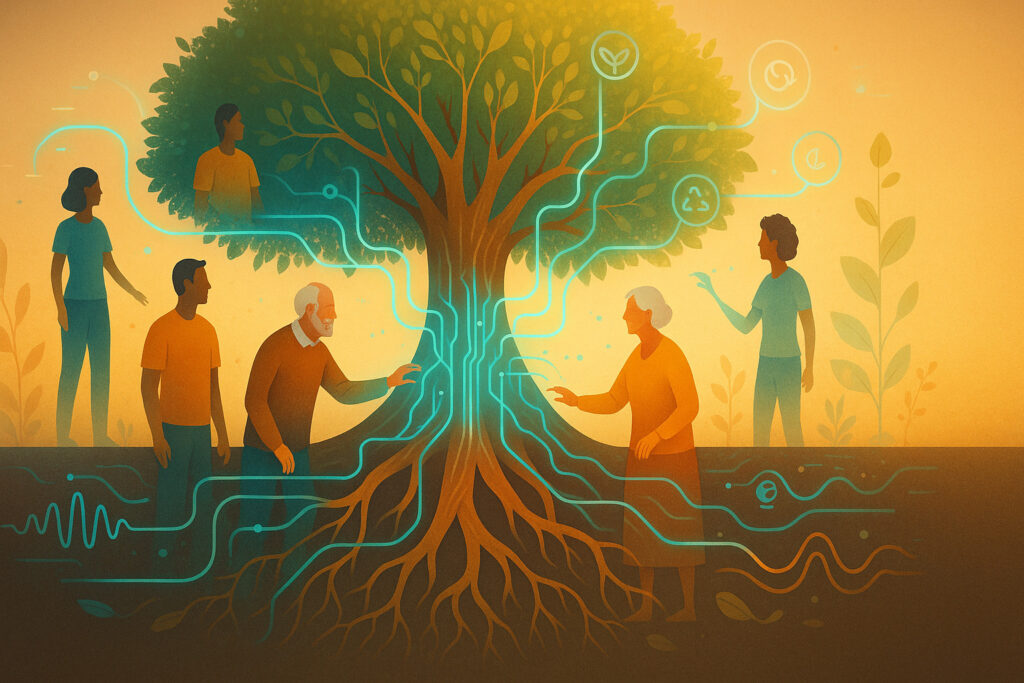
Integrating Artificial Intelligence (AI), and particularly its powerful subset Generative AI (GenAI), into the fabric of adult learning is a nuanced endeavour. It’s not merely about introducing the latest technological gadgets or software; it’s fundamentally about leveraging these tools in ways that genuinely resonate with and support the distinct ways in which adults learn most effectively. To achieve this meaningful integration, a solid understanding of andragogy – the theory and practice specifically focused on adult learning – is indispensable. Simply “bolting on” AI tools without careful consideration of the unique characteristics, intrinsic motivations, diverse experiences, and preferred learning styles of adult learners is a strategy unlikely to yield good engagement, deep learning, or successful educational outcomes. Instead, it might lead to frustration, disengagement, or the superficial use of powerful technologies.

CORE PRINCIPLES OF ADULT LEARNING (ANDRAGOGY)
To build a framework for effective AI integration, let’s revisit some of the foundational principles of how adults typically learn, as articulated by Malcolm Knowles and other prominent andragogy theorists:
Adults are pragmatic learners. They are most motivated to invest time and effort in learning when they clearly understand why a particular piece of knowledge or skill is important to them. They want to see its direct relevance and how it will benefit them personally or professionally, help them solve a pressing problem, or apply directly to their current life situations and work responsibilities. The “what’s in it for me?” question is often paramount.
Adults generally possess a strong self-concept as independent, self-directing individuals. They prefer to take responsibility for their own decisions, including those related to their learning paths and processes. They value autonomy and appreciate having some degree of control over what, how, when, and where they learn.
Adults do not come to learning situations as blank slates. They bring with them a vast and rich reservoir of life experiences, prior knowledge, existing skills, and established perspectives. This accumulated experience is a highly valuable resource that can (and should) be acknowledged, respected, and actively utilised as a foundation for new learning. Connecting new information to past experiences enhances meaning and retention.
An adult’s readiness to learn is often closely tied to their life tasks, social roles, or developmental stages. They are typically most receptive to learning those things they perceive as immediately necessary to know or be able to do in order to cope effectively with their real-life situations, current job demands, personal challenges, or upcoming transitions.
Adult learning is generally problem-centred or task-oriented rather than purely subject-centred (as is often the case in traditional pedagogy for children). Adults prefer to learn skills and knowledge that they can apply immediately to solve real-world problems, complete specific tasks, or improve their performance in a tangible way. They seek practical application.
While external motivators (such as the prospect of a promotion, a salary increase, or obtaining a required certification) can certainly play a role in an adult’s decision to learn, internal motivators are often more powerful, sustainable, and lead to deeper engagement. These intrinsic drivers include the desire for increased self-esteem, greater job satisfaction, improved quality of life, the intrinsic satisfaction of mastering a new skill, or the sheer joy of learning and intellectual stimulation.
These andragogical principles should serve as the guiding philosophy – the fundamental “operating system” – upon which we design and implement AI applications within adult learning environments. AI tools should not be imposed but thoughtfully woven into learning experiences in ways that honour and leverage these principles. For example, within the context of the HER[AI]TAGE project, an AI tool that empowers an adult learner to explore complex information about the preservation of intangible cultural heritage at their own pace and according to their specific interests (addressing their need to know and supporting self-concept) or assists them in collaboratively planning a community event to share local stories (making the learning problem-centred and leveraging experience) will be far more impactful and better received than an AI tool that simply presents decontextualised information or dictates a rigid learning path.
The following table shows how AI can align with these principles:
| Andragogical principle | Brief explanation of principle | AI integration strategy / tool functionality | Example application (HER[AI]TAGE context if applicable) |
| The learner’s need to know | Adults are motivated to learn when they understand the relevance and benefit of the knowledge/skill to their lives or work. | AI tools can generate real-world examples, case studies, or simulations demonstrating practical application. AI chatbots can answer “why” questions immediately. | AI can create scenarios showing how documenting Traditional Ecological Knowledge (TEK) for HER[AI]TAGE directly helps preserve local identity and environmental wisdom, addressing the “need to know” for community members. |
| Self-concept and autonomy | Adults see themselves as self-directing individuals and prefer control over their learning. | AI-powered learning platforms can offer personalised learning paths, allowing learners to explore topics at their own pace and based on their interests. AI tutors provide on-demand support. | Learners in a HER[AI]TAGE course use AI tool to research specific aspects of intangible cultural heritage (ICH) that pique their interest, choosing their depth of study. |
| The role of experience | Adults bring a wealth of life experiences and prior knowledge, which should be used as a resource for new learning. | GenAI can be prompted to create content or adapt materials that connect to learners’ diverse backgrounds, professional contexts, or cultural perspectives. | In a HER[AI]TAGE workshop, adult learners use AI image generators to create visuals for a local story, prompting the AI based on their personal memories and understanding of the region’s history and environment. |
| Readiness to learn | Adults’ readiness to learn is often tied to developmental tasks, social roles, or immediate needs. | AI can provide “just-in-time” support for tasks learners need to perform, offering immediate explanations or resources relevant to their current challenges. | A HER[AI]TAGE volunteer uses an AI tool to quickly find best practices for digital audio recording just before conducting an oral history interview. |
| Orientation to learning | Adult learning is generally problem-centred or task-oriented, focusing on immediate application to real-world situations. | AI tools can assist in solving real problems, drafting project plans, or generating solutions for case studies. | A community group uses an LLM to collaboratively brainstorm a project plan for a HER[AI]TAGE exhibition, using AI to identify challenges and solutions. |
| Motivation to learn | Intrinsic motivators (e.g., self-esteem, job satisfaction, joy of learning) are often more powerful for adults than purely external ones. | AI can provide rapid, individualised feedback on drafts or ideas, building confidence and showing progress. AI can also generate creative prompts that spark curiosity. | An adult learner drafting a narrative based on a HER[AI]TAGE story receives instant AI feedback on clarity and impact, boosting their motivation to refine their work. |

PRACTICAL STRATEGIES FOR ALIGNING GENAI WITH ANDRAGOGICAL PRINCIPLES
Supporting self-direction and addressing the need to know
GenAI tools, such as sophisticated AI-powered chatbots or virtual tutors, can significantly empower adult learners by allowing them to explore topics in depth, at their own individual pace, and according to their own curiosity. They can ask clarifying questions at any time without the fear of judgment that might exist in a group setting, and pursue highly individualised learning paths based on their specific interests, prior knowledge, and identified needs. For instance, an adult learner engaging with complex historical documents or policy papers related to the HER[AI]TAGE project (e.g., on ICH nomination processes or digital archiving standards) could use an AI tool to get instant, tailored explanations of unfamiliar terminology, historical contexts, or intricate procedural steps. Furthermore, AI can be instrumental in clearly articulating the “why” of learning. It can generate compelling real-world examples, relevant case studies, or simulated scenarios that vividly demonstrate the practical relevance and application of the content to the learner’s personal life, professional field, or community involvement.
Leveraging experience and ensuring relevance
GenAI can be skilfully prompted to create new educational content or adapt existing materials in ways that explicitly acknowledge and incorporate learners’ diverse backgrounds, professional contexts, community-specific issues, or cultural perspectives. For example, in a HER[AI]TAGE-related workshop focusing on environmental stewardship, an educator could ask GenAI to generate a series of case studies that focus on environmental challenges and traditional ecological knowledge specifically relevant to the Drava, Mura, or Danube river regions, tailoring these scenarios to reflect the professional experiences (e.g., farming, fishing, tourism) or community concerns of the participating adult learners. This capability allows for a profound degree of personalisation in adult learning, adapting explanations, examples, tasks, and even the level of complexity to an individual’s prior knowledge and interests, at a scale previously difficult to achieve.
Facilitating problem-centred learning and immediate application
GenAI can function as an invaluable “just-in-time” learning support system. It can provide on-demand explanations of difficult concepts, quickly locate relevant resources or data, or even suggest potential frameworks or solutions when a learner encounters a specific problem or needs to perform a particular task in a real-world context. For example, a learner participating in a hands-on HER[AI]TAGE community workshop focused on the practical aspects of preserving local oral histories could use AI tools to instantly research best practices for digital audio recording, ethical interviewing techniques, or metadata standards for archiving oral testimonies. They might also use AI to brainstorm innovative solutions for engaging younger generations with this heritage.
Enhancing readiness to learn and boosting intrinsic motivation
AI tools can provide rapid, specific, and individualised feedback on learners’ drafts, practice exercises, project proposals, or creative ideas. This immediate and actionable feedback can help keep the learning process relevant, build learners’ confidence by highlighting strengths and areas for improvement, and sustain their motivation by showing clear paths to progress. For example, an adult learner tasked with drafting a compelling narrative based on an elder’s story collected for the HER[AI]TAGE project could use an AI writing assistant to get instant suggestions on improving the story’s clarity, emotional impact, stylistic consistency, or engagement factor. This direct and timely application of feedback to a meaningful and personally relevant task can significantly boost their readiness to learn and tap into powerful intrinsic motivators.

THE EDUCATOR’S EVOLVING ROLE IN AN AI-ENHANCED ANDRAGOGICAL APPROACH
The thoughtful integration of AI into adult learning environments inevitably necessitates an evolution in the educator’s role. They transition from being primarily a dispenser of content to becoming more of a:
- Guide and facilitator: Skilfully helping learners to navigate the landscape of AI tools, select appropriate ones for their tasks, and use them effectively and ethically.
- Critical thinking partner: Actively encouraging and modelling how to critically evaluate the information, suggestions, and outputs generated by AI, fostering a healthy scepticism and analytical mindset.
- Connector and contextualiser: Helping learners to see the connections between AI-driven activities, broader learning objectives, their own experiences, and real-world applications, ensuring that learning remains meaningful.
- Meta-cognitive coach: Supporting learners in reflecting on their own learning processes, understanding how AI can enhance their learning strategies, and developing self-regulated learning skills.
In essence, the educator acts as the crucial “andragogical AI interface,” ensuring that the chosen technology serves sound educational principles and genuinely meets the unique and diverse needs of adult learners. They don’t just teach about AI; they teach with AI in a manner that respects, leverages, and enhances the powerful ways in which adults learn.
PRACTICAL EXAMPLES
An adult learner, deeply interested in the specific traditional boat-building techniques mentioned in a HER[AI]TAGE oral history, uses an AI-powered research assistant. They ask targeted questions about obscure terminology, historical tools used, and regional variations. The AI not only provides textual answers but also links to relevant academic articles, museum archives with images, and even video demonstrations of similar craft traditions, allowing the learner to delve into the topic at their own pace and to the depth they desire, far beyond what might be covered in a standard curriculum.
During a workshop on digital storytelling for the HER[AI]TAGE project, adult learners – some of whom are retired teachers, skilled craftspeople, local historians, or environmental activists – are encouraged to use an AI image generator. They are prompted to create visuals that reflect their unique personal understanding and emotional interpretation of a shared local legend or a significant historical event related to their river. They draw upon their own rich life experiences and professional backgrounds to inform the descriptive prompts they feed to the AI, resulting in a diverse and deeply personal collection of visual interpretations.
A community group, inspired by the HER[AI]TAGE project, decides to document and create an online interactive archive of traditional local recipes and the stories behind them. They use an LLM collaboratively to brainstorm a comprehensive project plan. This includes using the AI to identify potential challenges (e.g., standardising diverse recipe formats, ensuring digital accessibility for all age groups, intellectual property considerations for shared stories) and to generate creative ideas for actively involving community elders and younger generations in the collection and curation process.
An adult learner is practicing writing grant proposals to secure funding for a small-scale cultural preservation project they are passionate about (e.g., restoring a local historical landmark or digitising a collection of old photographs). They use an AI writing assistant, providing it with the grant guidelines and their draft proposal. The AI offers immediate, specific feedback on the clarity of their project objectives, the persuasiveness of their impact statement, the completeness of their budget justification, and overall alignment with the funder’s priorities. This iterative feedback loop helps them refine their skills rapidly and boosts their confidence and readiness to submit a high-quality, competitive application.
An educator running an online course on sustainable tourism practices in sensitive ecological areas (like those along the HER[AI]TAGE rivers) uses AI to generate initial discussion prompts that present complex ethical dilemmas (e.g., balancing economic benefits with environmental protection). They then skilfully facilitate the online discussion, encouraging learners to share their diverse perspectives and experiences, critically evaluate any AI-generated information or solutions presented, challenge assumptions, and collaboratively develop nuanced and contextually appropriate sustainable tourism strategies. The educator also models how to fact-check AI claims and identify potential biases in AI-generated case studies.
An adult learner wants to improve their public speaking skills for community presentations. They use an AI tool that records them practicing a speech, then provides feedback on pace, filler words, clarity, and even estimates audience engagement based on vocal tone. This directly addresses their need to improve a practical skill (orientation to learning) and allows them to practice and receive feedback independently (self-concept).